

Susan Narjala
Keeping it Real
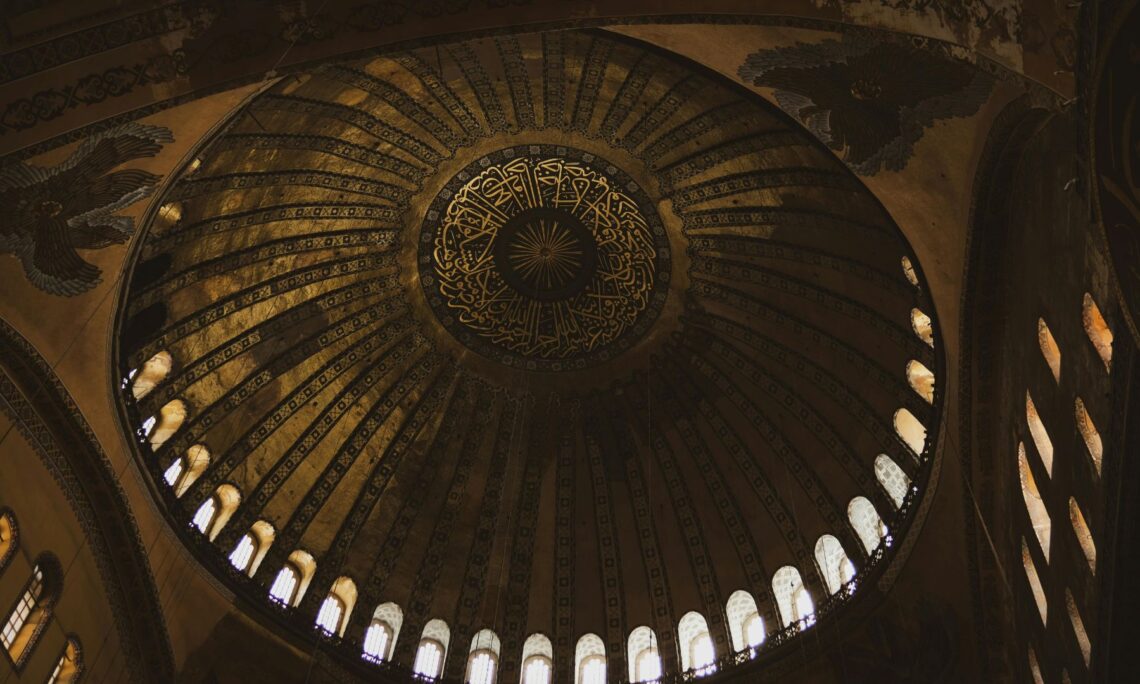
What I Learned about God — at a Mosque
As I tilt my head at a certain angle, I catch a glimpse of the shimmering domed ceiling. Though I want to linger, the crowd behind me feels overwhelming — I only take a moment to glance at the mosaic: Mary, robed in a deep blue, sits on a jeweled throne. She holds a young Jesus who carries a scroll—a symbol of the Word of God.
It’s beautiful. But what’s even more stunning is where it’s found. Not in a cathedral. Not in a chapel. In a mosque.
Last week, my husband and I celebrated our anniversary with a trip to Turkey. As our tour guide led us through the Hagia Sophia mosque in Istanbul, we caught sight of this incongruous image.
Here’s the back story. (If you’re a history buff, read on. If not, you can skip this bit.) The Hagia Sophia was built in the 6th century by a Byzantine Emperor as a cathedral, the center of Eastern Orthodox Christianity for nearly 1,000 years. Later, under the Ottoman Empire, it was converted to a mosque — but the original mosaics were not destroyed. Instead, they were covered over with plaster and paint. In the 1930s, when the mosque was turned into a museum, the Christian mosaics were uncovered. But only for a brief time: from 2020 on, Hagia Sophia has been turned back to a mosque. Today, while the mosaics are covered by curtains during Muslim prayers, they are visible to visitors at other times.
As I stood there, that image became a kind of parable for me.
There are seasons when God’s presence feels unmistakably near. But we all experience those times when our vision of Him is obscured by our circumstances. Much like the concealed ceiling during different kingly reigns, God seems hidden, maybe even absent. But, the truth is, He always sees us. He is always working — whether we see Him or sense His presence or not.
Consider the life of Joseph in the book of Genesis (chapters 37-50). Often, we think of his life as an upward trajectory from pit to prison to palace. We assume that God finally brought Joseph to a place of blessing at the palace. But the truth is, God was with Joseph and orchestrating the circumstances of his life even in the pit and the prison.
We know Joseph’s entire life story from the Bible — that he ended up a ruler, second only to Pharaoh. But Joseph didn’t have the big picture. When he looked up in the darkness of the cistern that his brothers had thrown him into, did he see God’s hand? When he was unfairly sentenced to the confinement of prison, could he sense God’s heart?
The truth is, whether Joseph could see God in those dark moments or not, God was weaving Joseph’s story in the pit and the prison.
Was it happenstance that Reuben persuaded the other brothers not to kill him?
Was it merely a coincidence that the cistern was not filled with water or that the Ishmaelites happened to pass by?
Was it simply serendipity that he ended up working for Potiphar? Or that he had the gift to interpret the dreams of the baker and the cupbearer in prison?
No, God was working out every circumstance for Joseph’s good and His glory — whether he could see it or not.
Friend, maybe you’re in a pit or prison of sorts where life feels dark, lonely, confined, or limited in some way. God may be preparing you for the palace or preparing the palace for you. But even in the pit and the prison, He is with you and He is working all things out for you.
Like the curtain at the mosque in Istanbul, your circumstances could be veiling your view of God. Maybe you look to the heavens and ask, “God where are you?” — only to hear the echo of your own voice. Only to see plaster and curtains. But the truth is, He sees you.
The pit and the prison don’t just prepare you for the palace. They are holy ground where God meets with you. May we trust Him even when we cannot see His face. May we believe in Him even when we cannot feel His presence. May we lean into Him even when we cannot hear His voice.
Where You Can Find My Writing This Month
Links to where my words have travelled in October
Following Jesus In the Age of Influencers – On The Gospel Coalition India
How can Christians leverage the power of digital tools to serve the purposes of God, not conform to the patterns of social media influencers?
Overwhelmed by the World? Pray Like Daniel Did – On the Bible Study Fellowship (BSF) Blog
When Daniel understood the prophecy about Jerusalem’s desolation from his reading of Scripture, his first response wasn’t resignation. Instead, he got on his knees.
If this blog resonated with you, SUBSCRIBE to my weekly newsletter for FREE so you get my posts delivered to your inbox. I would love a Facebook or Instagram follow or share if you’re on social media. Thanks a ton for stopping by! See you next week.
MEET SUSAN

Comments
7 Comments
Josephina
Thank you Susan for this timely reminder from God that He is working even when my vision of Him is obscured and He seems hidden and absent. For now, the pit and the prison loom larger than the palace but I know that the Story is His as is the Glory. May His Name be praised in every corner of this, His created, world!
Blessings as you celebrate this Anniversary and many more to come 🙂
Susan Narjala
Amen! Thank you, Josephina! Thank you for sharing about how large the pit and the prison seem to be right now. Praying that Jesus would reveal His near presence and help in the broken places of our lives. Thank you for the anniversary wishes. God bless. Susan
Peter
Amen! May we be granted sight beyond seeing. Beyond what’s visible, beyond the veil. As God ‘apocalypses’ holy wonder.
“Never once in my life did I ask God for success or wisdom or power or fame. I asked for wonder, and he gave it to me.” — Rabbi
Abraham Joshua Heschel.
Pit and Prison as purposeful purgative precincts of transformative Presence and gentle grace — covenant faithfulness that neither abandons us to our worst selves and circumstances, self-inflicted or not (did Joseph really need to rub it in about his ‘too-special-for-you-lot’ dreams? Not to mention Jacob’s blindness to his extravagant paternal preference and prejudice — that coat was a neon sign and. As done with an advanced degree as master manipulator, was this his blindingly benign display of fatherly love, innocently blind to its consequences? Or was it a pitiful (pun on pit intended) and pathetic replay, possibly even pure projection, of what Jacob suffered at the hands of his own father and brother. He was mama’s boy in more ways than one, just that this time it neither a meal nor mandrakes as means?)
The Rabbinical midrash on the Joseph-Potiphar confrontation is an eyebrow raiser for sone, an imaginative eye-roller for others.
Very likely that these close to four centuries worth of meditations and massages in the form of thousands of Rabbinic midrash were in ready recall around the time of Jesus, as they circulated in colloquial conversation. The way we are wont to announce, prefacing our home-cooked homily with ‘What the Bible really says is…’, is based on an accumulation of Sunday sermons, weekday Bible studies, YouTube videos, Insta reels, et al; mostly Godly good folks quoting other Godly good folks more than we’ve cared to realise. These are nearly always well intended, seldom little else.
If inclined, do a Google search of this particular Potiphar (gift of god — the sun god ‘ra’) and Joseph (God will increase) midrash.
Joseph’s almost uncharacteristic “You meant it for evil but God meant it for good” (a statement warranting a month’s meditation by itself — if nothing else, but in the way is contrasts his older Jewish brothers who aren’t living as pagans in service to a pagan pharaoh in a pagan land, but have arrived from their ‘fathers house’ in need of food — let’s not forget that by now little brother lord Joey is performing as an image of the pharaoh, continuing the scourge of grinding all the neighbouring kingdoms in to poverty and abject slavery just to stay alive. The perverse purpose of pharaoh’s bully barns brimming with wheat. Already the story is going with hyperlinks to so many other stories in both Testaments).
Which does reveal that the lessons of the put and prison, while destiny altering, aren’t as totally transformative or a permanently purging as we are more comforted in imagining.
The beauty is in neither the pit nor the prison. But in the person of a God who is present, ever-present. If that creeps me out, my crawling skin only signals my profound ignorance of who God is.
Nothing is out of his remit when it comes to saving us. Every righteous boundary we draw for God he destroys with flair and delight. Yes, even that dreaded, nightmare-inducing, ship-swallowing sea monster Leviathan is his ‘play pet’. This terrifying beast more readily recognises and responds to God in humble obedience than his chosen prophet Jonah!
Nothing can disqualify or separate us from God’s love.
That’s what makes pit or prison sacred ground.
Thank you this blessed reminder of the un-restrainable, relentless, stubbornly faithful love of God.
Blessings
Lauren Scutari
Thank you! That is a beautiful reminder that God never leaves us nor forsakes us.
Susan Narjala
Amen. What a promise we get to stand on. Thanks, Lauren, for writing in. Blessings, Susan
Ted Senapatiratne
Thanks Susan for the blog and a lot to think about … to mull and even go on some rabbit trails!!
And a Happy Anniversary to you and your husband, and Congratulations and much Blessings!
Susan Narjala
Thanks so much, Ted!:)